Just Write

Lately, the morning routine has become a refuge for me- quiet time at the beginning of a new day. Coffee and another post.

On occasion, it feels like the cart before the horse. I get up and get settled with no idea what the topic is going to be. Other times, there’s something that’s been bubbling up, clamoring for the light of day.

This is one of those cart-before-the-horse mornings.

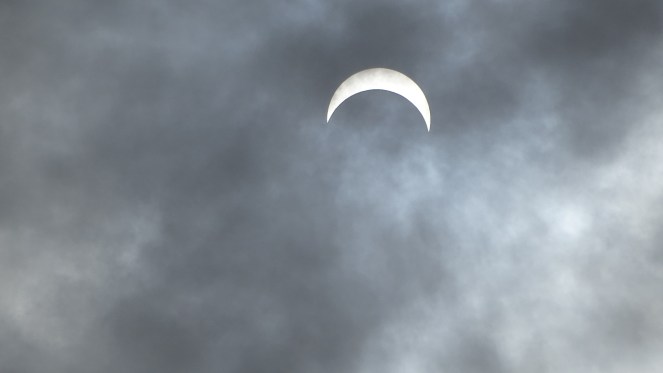
Well, at least I updated the previous post with a picture from yesterday’s eclipse. That worked out pretty well- no eye damage and, as far as I can tell, no damage to my camera. And now there’s a record of the event.

Syzygy

Hopefully the conditions are decent for folks. With all the build-up, it’d be kind of a bummer not to be able to catch at least a glimpse of the solar eclipse today- total for some, partial for most. The next opportunity will be a partial eclipse in some areas of the country in 2023, or a total eclipse for some in 2024. Or if one has the means, just travel to the spot where the next one is scheduled. Various types of eclipse happen with some regularity around the world.

Apparently, the moon’s increasingly elliptical orbit means that in about 600 million years, there won’t be any more solar eclipses. So try not to miss the next one when it comes around.

May the skies be clear.

UPDATE:

DSC00409
2:42 pm, Southeastern PA, 8/21/17

Quiet

For a number of years, beginning with my time in Boy Scouts, we would make our way to New Hampshire in the Fall to climb a 4000-footer.   I know- all the folks who live in the Rockies would be going “Ooh, a four thousand footer…”  I guess it’s relative, in a way, based on conditions and the altitude at which one starts a climb. And oxygen levels aren’t as much of a concern in NH.

Anyway, we would spend an entire day hiking somewhere in the White Mountains- Cannon Mountain, Mt. Osceola, Mt. Garfield, Mt. Moosilauke. Other times higher ones like Lincoln, Lafayette, even Mt. Washington on a couple of occasions.

At some point in the hike, we would be far enough away from the trail head yet still below the tree line, out of ear shot of road noise and not quite exposed to the wind that was usually present at the higher elevations.

We would come to spots where there would be hardly any sound. No babbling brook, not even the rustle of a leaf. It wasn’t eerie, but it would get your attention. It was beautiful- that we could be outdoors, on the side of a mountain, and not hear anything. We would pause just to take it in for a few moments.

A lasting sensory memory.

Color

The Bible doesn’t have as much authority as people want it to have, at least in certain areas of our life experience.

Think about it. While it continues to speak eloquently in some ways to our human condition, it is a collection of letters and poems, prose and laws, the most recent of which was written around 1900 years ago, with the balance of contributions written over the course of about 1200 years prior to that. 

In the midst of what has been lost in translations, and what has been molded and shaped to support various world views and interpretations of the texts (i.e. the many versions of the bible that exist), there is a desire for scripture to offer guidance and authority on topics for which it is not ideally suited to speak.

For starters, slavery and sexuality. Yes, the references to slavery are numerous in both the Old and New Testaments. But that was then. This is now. And slavery to sin is a whole other thing.

The allusions to sexual preferences and habits have been debated to death, without clear resolution.

We cherry-pick texts that resonate with our gut feelings and perpetuate stereotypes and wrong-headedness, without regard to current conditions on the ground, including in our own families. Without regard for knowledge that wasn’t available two- or three thousand years ago. Without regard for evolution in thought and understanding of what it means to be human.

Without, seemingly, regard for the gospel witness concerning Jesus of Nazareth, whose love for all of creation was made clear in his earthly ministry and his death on a cross.

Saul who became Paul, in his letter to the church in Galatia, claims that “there is no longer Jew or Greek, there is no longer slave or free, there is no longer male or female…”

If we’re going to cling to words of scripture for guidance and direction, we’d do well to move away from the ignorance and naivete of certain ancient understandings and prohibitions, and toward the freedom of the gospel. Toward grace and a release from the weight of judgment of ourselves and others.

Who do we think we are, anyway?
Words

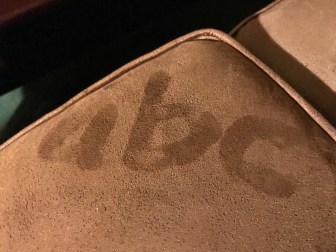
IMG_0519

Spoken, written, texted, tweeted. The sheer volume of verbiage that finds its way to expressed form on a daily basis must be colossal.

I remember a seminary professor describing words as being like arrows- once released, there is no getting them back. Things are set in motion, for better or worse. Impressions are made, messages are sent, opinions are formed.

Words heal and wound. They compliment, denigrate, conflate, conflict, clarify, confuse, deflect, distract. Words inspire and anger. They fan the flames or pacify. A command of the English or any language is a formidable tool. Or weapon.

They may not speak as loudly as actions, but words generate their own sound intensity. And through them, we are given glimpses into who people really are.

Boredom

The word, in certain contexts and variations, really gets under my skin. “This is boring…” “I’m so bored…”  Well, your choice of words is boring. A real yawner.

According to an article in The Guardian, boredom “is not a problem to be solved. It is the last privilege of a free mind.” The tag line that follows suggests that one “lean into boredom, not your smartphone screen. You’ll learn more about yourself and the world around you than you think.”

The “cure” is not a packed schedule or some sort of adrenaline rush. It’s not finding a hobby or cleaning your house. Boredom is not tragic, according to Gayatri Devi. It’s an encounter with pure time as form and content. And we shouldn’t be in such a hurry to avoid it.

Granted, sometimes we just need to get moving and do something constructive, be useful, contribute.

But not always. Sometimes it’s a luxury to have a little while just to…

think.


Routine

Does everybody have a routine? Not a comic routine, but a repeated, even anticipated and welcome pattern to at least a portion of their day. Even folks who despise routine- are they really that intentional about living every single day differently than the day before? Or are folks bent on living atypical lives really just living a different sort of routine?

There is nothing riding on an answer to these questions. In the larger scheme of things, it’s not worth spending much time on. It’s just something that came to me while I paused to make my morning coffee and the topic for this post emerged.

I am a creature of habit, probably to a fault. I like predictability, which given my current line of work might seem odd. I’ve had the occasional call from a hospital or a parishioner that necessitated an abrupt change of plans, and have never appreciated these unanticipated interruptions. They do come with the territory, but this doesn’t mean I have to like them.

Sometimes routines seem a luxury to me. They are familiar and comfortable. Other times, they seem to be a sovereign with too much power, and I wish to be free of them.

I Love Technology

5BAB1018-D4BA-4D87-A015-77322B8BBD70
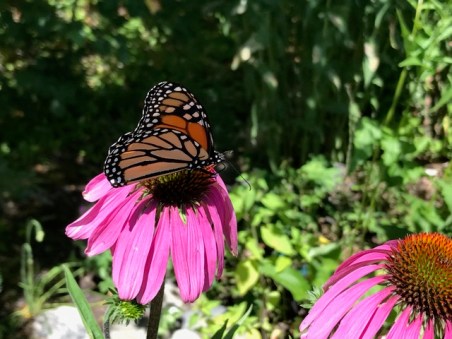
Coastal Maine Botanical Gardens, 7/17

This is going to sound like an advertisement, but I just want to thank the folks at Apple for including the Depth Effect in Portrait mode on the latest iPhone. It’s probably difficult to tell in this picture, but the original is strikingly clear and crisp. It truly pops on a larger screen- amazing foreground detail.

It doesn’t render a regular camera obsolete just yet- still needs a good telephoto option. But one has to wonder what’s in the works.


Moving Day

Though 63-plus years have come and gone, it’s still fun- and probably a bit sad- to think about what I want to be when I grow up. There would seem to be a time crunch anymore, and let’s throw timidity and resignation into the mix as well.

My current occupation/vocation is not one I’ve ever dreamed of doing. To this day, Musician or Astronomer or Barista sound much more interesting. It’s not that I haven’t learned things about life and faith and human nature over the last 22 years. My time as a pastor in a mainline/old line denomination has expanded my world view and shaped my politics. And at times I have truly appreciated not being tied to a 9 to 5 existence.

It’d just be nice to know the feeling of working at something that doesn’t feel like work. Maybe this is a luxury out of my reach now. Maybe there’s no small amount of selfishness involved in such a pursuit. Maybe everything feels like work at some point in the day.

Maybe.

I’d like to know the feeling of putting in a 12-hour day and being so totally immersed in tasks at hand that I little note the passage of time. I hear others say they can’t believe they get paid for what they do? I want to know what that is like.

I remember my father asking me, on several occasions, if I thought I’d ever amount to anything. I never took this personally- in context it seemed more tongue in cheek than some sort of put-down. Besides, I seem to recall him asking my brothers and sisters the same question. In retrospect, it might have had as much to do with how Dad felt about himself as it did his desire for his children to know a level of accomplishment and satisfaction that, in his mind, had passed him by.

Or maybe he was just worried about me.

Anyways, I always answered “yes” to Dad’s question, with little basis for such confidence. Besides- to some extent, it’s not up to me to assess whether or not I’ve amounted to anything.

To the extent that it is up to me, I still feel like the jury is deliberating. Like I’m still on the road, as the former Cat Stevens once sang, to find out.

Far Out

A recent learning was that Edwin Hubble did research at Caltech starting back in the early 1930s. Dr. Hubble, according to his Wikipedia page, played a crucial role in establishing the fields of extragalactic astronomy and observational cosmology. He discovered an asteroid known as 1373 Cincinnati. More significantly, he deepened our understanding of an expanding universe.

The orbiting telescope named in Dr. Hubble’s honor settled into its low earth orbit at around 335 miles and became operational in May of 1990. The Hubble has provided a stream of mind-blowing photos, giving us spectacular images of nebulae and galaxies and our own planetary neighbors. This instrument has led scientists to deeper understandings of, among other things, the rate of the universe’s expansion- work for which Dr. Hubble himself helped lay the foundation.

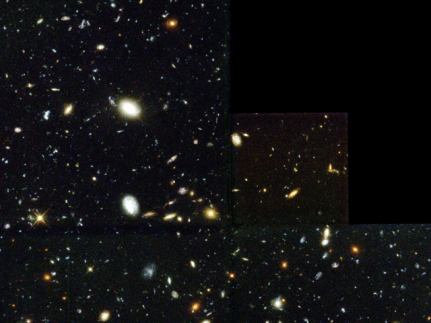
Of all the pictures from Hubble, the first one that made my jaw drop is the Deep Field North, constructed from a series of observations, over a ten-day period, of a minuscule section (one 24-millionth) of the sky in Ursa Major (the Big Dipper), with an equivalent angular size of viewing a tennis ball from a distance of 100 meters, or roughly 110 yards. I seem to recall another analogy comparing this to looking at a dime edgewise from a distance of 70 feet. There have been other Deep Field composites since- the Ultra Deep Field and Extreme Deep Field- but when the first one was made public, it was an attention-getter.

According to Wikipedia, the field of view is so small that only a few foreground stars in the Milky Way lie within it, which means that almost all of the 3000 objects in the image are GALAXIES! Galaxies contain anywhere from hundreds of millions to trillions of stars. The distance across galaxies is measured in light years, sometimes thousands of light years.

A light year is a unit of astronomical distance- the distance light travels in one year at a speed of 186,000 miles per second, or 671 million miles per hour…

IMG_0030

Almost 6 trillion miles.

It’s fun trying to get your head around that.